Growth Doesn't Have to Be a Leap — Sometimes It's Just a Small Step You Actually Take
There is a very specific kind of motivational content that has colonized every corner of the internet, and it goes something like this: your comfort zone is a cage, real growth only happens when you're scared, and the fact that you haven't blown up your life yet is basically proof that you're settling.
It's compelling. It's also, for a lot of people, completely counterproductive.
Not because growth isn't real. It is. Not because discomfort is never useful. It can be. But because the narrative that meaningful change requires constant risk-taking, dramatic pivots, and performed courage has quietly convinced a lot of people that if their transformation doesn't look cinematic, it doesn't count.
And that belief, more than any so-called comfort zone, is what's actually keeping people stuck.
The Problem With the Leap
Let's talk about what actually happens when someone makes a big, dramatic change under pressure — social pressure, motivational content pressure, the pressure of turning thirty and feeling like they should have done something by now.
Sometimes it works out. You quit the job, the freelance career takes off, the move to Austin was exactly what you needed. Great. Those stories are real, and they're worth celebrating.
But for every one of those, there are a dozen stories that don't make it into the highlight reel. The person who quit their job in a blaze of inspiration and spent the next eight months anxious and financially unstable. The dramatic relationship ending that, in retrospect, was more about feeling like they were doing something than actually knowing what they wanted. The complete lifestyle overhaul that lasted six weeks before collapsing under its own weight.
Dramatic change is exciting. It's also fragile. Because it's usually built on momentum and emotion rather than infrastructure and clarity — and when the momentum fades, there's not much left to hold it up.
What Sustainability Actually Looks Like
Here's the less exciting truth: most lasting transformation is quiet. It accumulates. It doesn't make for a good Instagram caption because it looks, from the outside, like almost nothing.
It looks like the person who starts going to therapy and slowly, over eighteen months, stops reacting the same way they always have. It looks like someone who starts cooking one more meal at home per week and, two years later, has a genuinely different relationship with their body and their budget. It looks like someone who starts saying no to one thing that drains them, and then another, and eventually finds that their life has more room in it than they thought possible.
None of these are leap-off-the-cliff moments. All of them are real change.
The research on habit formation and behavior change has been fairly consistent on this point for years: small, specific, repeatable actions tend to produce more durable results than large, sweeping ones. Not because ambition is bad, but because the brain adapts more effectively to gradual shifts. You build identity through repetition, not through single dramatic acts.
Why We're Addicted to the Big Move
So if small, intentional steps actually work better, why are we so drawn to the dramatic version?
Part of it is cultural. American culture has a deep romance with reinvention — the fresh start, the comeback story, the person who left everything behind and found themselves. It's baked into the mythology. We love a transformation arc.
Part of it is social media, which rewards the visible and the dramatic. A post about how you just booked a one-way ticket gets ten times the engagement of a post about how you've been quietly working on your relationship with money for the past year. The algorithm doesn't care about the unglamorous stuff. So we start to believe the unglamorous stuff doesn't matter.
And part of it — maybe the biggest part — is that big, dramatic moves feel like proof. Proof that you're serious about changing. Proof that you're not just talking about it. Proof that the discomfort you're feeling is actually going somewhere.
But proof for whom? That's the question worth sitting with.
Rethinking What Courage Actually Is
There's a version of courage that looks like jumping. And there's a version that looks like showing up, consistently, for something that matters to you — even when it's boring, even when the progress is invisible, even when nobody's watching or applauding.
The second one is harder than it sounds. It doesn't give you the adrenaline hit. It doesn't let you point to a single moment and say that's when everything changed. It requires patience with a process that isn't linear and trust that the accumulation of small choices is actually doing something.
That's not settling. That's not playing it safe. That's a different kind of brave.
A More Honest Exit Strategy
If you're in a place where something needs to change — a job, a relationship, a habit, a pattern — the question worth asking isn't how do I blow this up? It's what's the smallest true step I can take right now?
Not the smallest comfortable step. Not the step that lets you avoid anything hard. But the smallest step that's actually honest about what you want and where you're headed.
Maybe that's one conversation you've been avoiding. One boundary you've been soft on. One morning routine you actually follow through on instead of designing elaborately and abandoning by Wednesday.
Start there. See what it builds into. Give it more time than feels natural.
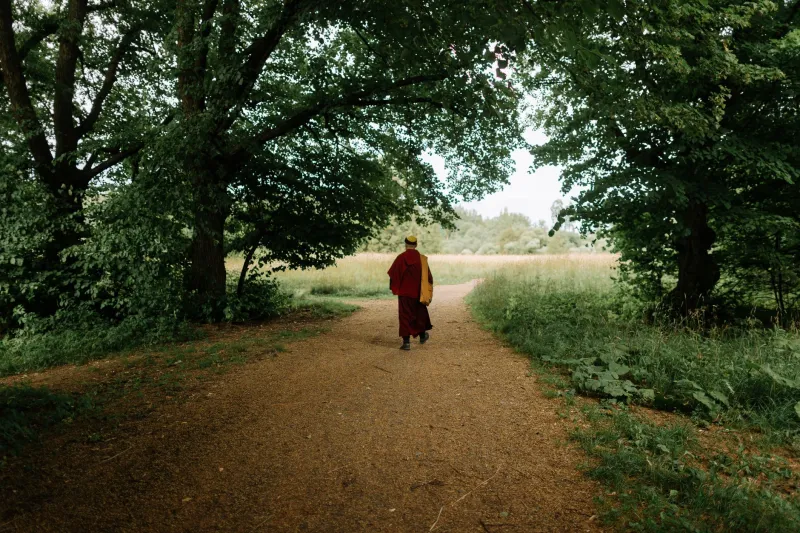
The leap looks better in the story you tell later. But the slow walk is usually what gets you somewhere real.